
Our Man in Japan: A Month with Ruskin and Ruskinians in the Land of the Rising Sun, by M. D. Usher
Over the summer of 2026, Companions Mark Usher (from the USA) and Rachel Dickinson (from the UK) each visited Japan, meeting and spending time with Guild Companions and other Ruskinians there. Each has written an illustrated account of their travels, both of them reflecting in particular on the warmth and generosity of the welcome and hospitality they received, and on the immense cultural value of the exchanges that are possible between members of our global Companionship. Read Mark's account below.
READ RACHEL DICKINSON'S ACCOUNT HERE
As a thought experiment (and an actual experiment), I’ve taken to writing a waka poem (in English) every day for this calendar year. As a new practitioner of Zen, it seemed like an appropriate outlet.
The waka form — a five-line, 31 syllable poem of 5-7-5-7-7 beats respectively — has been used in Japan for centuries to express all sorts. You can expound the Dharma, invite someone to dinner, bask in the light of the silvery moon, reject the flirtatious advances of a suitor, pillory a political opponent. Pretty much any topic’s fair game.
Here are a few waka ditties written on location during a month spent with Japanese Guild Companions and others this September while gathering material for my new next book WORK: An Ode to Joy, forthcoming from the University of Chicago Press.
This one was inspired by my reading of Sōetsu Yanagi, the originator of mingei, Japan’s functional equivalent of the Arts and Crafts movement inaugurated by Ruskin and Morris in England:
Everyday objects
Are subjects of vast beauty
Investigated
With chisels, spindles, brushes,
Out of fiber, clay, stone, wood.
Another, inspired by Japan’s awesome religious architecture:
In Japan you don’t
Enter a Shinto jinja
Where the kami lives.
You stand outside, rain or shine,
To worship gods of Nature.
This one pays homage to Buddhist nun, poet, and ceramicist from Kyoto, Rengetsu Ōtagaki (1791-1875):
Wakas in teacups.
Rengetsu Ōtagaki.
Drink down her poems
In one gulp. They will warm you
And leave you stone cold sober.
Here’s a lighthearted slight to the worst tendency in Japanese landscape design (by and large the exception rather than the rule):
Japanese gardens
Are serene and beautiful
But a bit also
Like miniature golf courses
Under terrarium glass.
And two reflections on the impression left on me by the astounding decency of Japanese culture:
A train conductor
In Japan bows to the car
Before entering
And then again when he leaves
With blue-collar bushido.
And then, by contrast, on the flight home . . .
On Japan Airlines
To Chicago ORD,
Descending from clouds
Of courtesy and respect
Only to wake up in hell.
And, finally, there is this one, the ostensible purpose of my visit to the Ruskin-Morris Centre of Osaka (ORMC), where I gave a lecture on our man Ruskin and the strange intersection of his thought with French philosopher Georges Bataille (1897-1962):
To work is to waste
A surplus of energy.
Working exudes Life.
That’s the cost of anything
Worth having or worth doing.
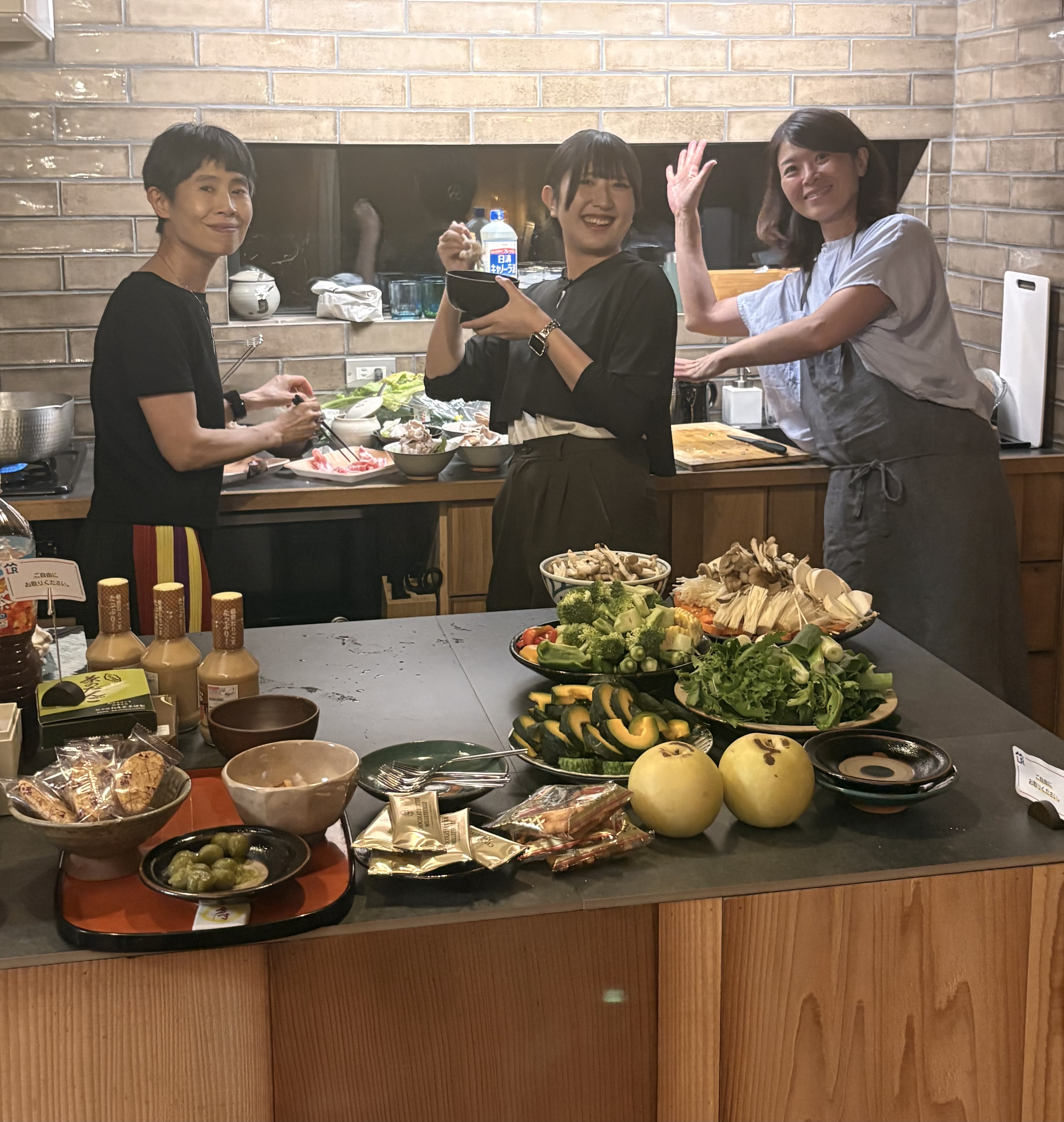
Chiaki Yokoyama, Ikuko Kurasawa, and a jubilant member of Studio-L (center) preparing dinner after a workshop at the Ruskin-Morris Centre of Osaka.
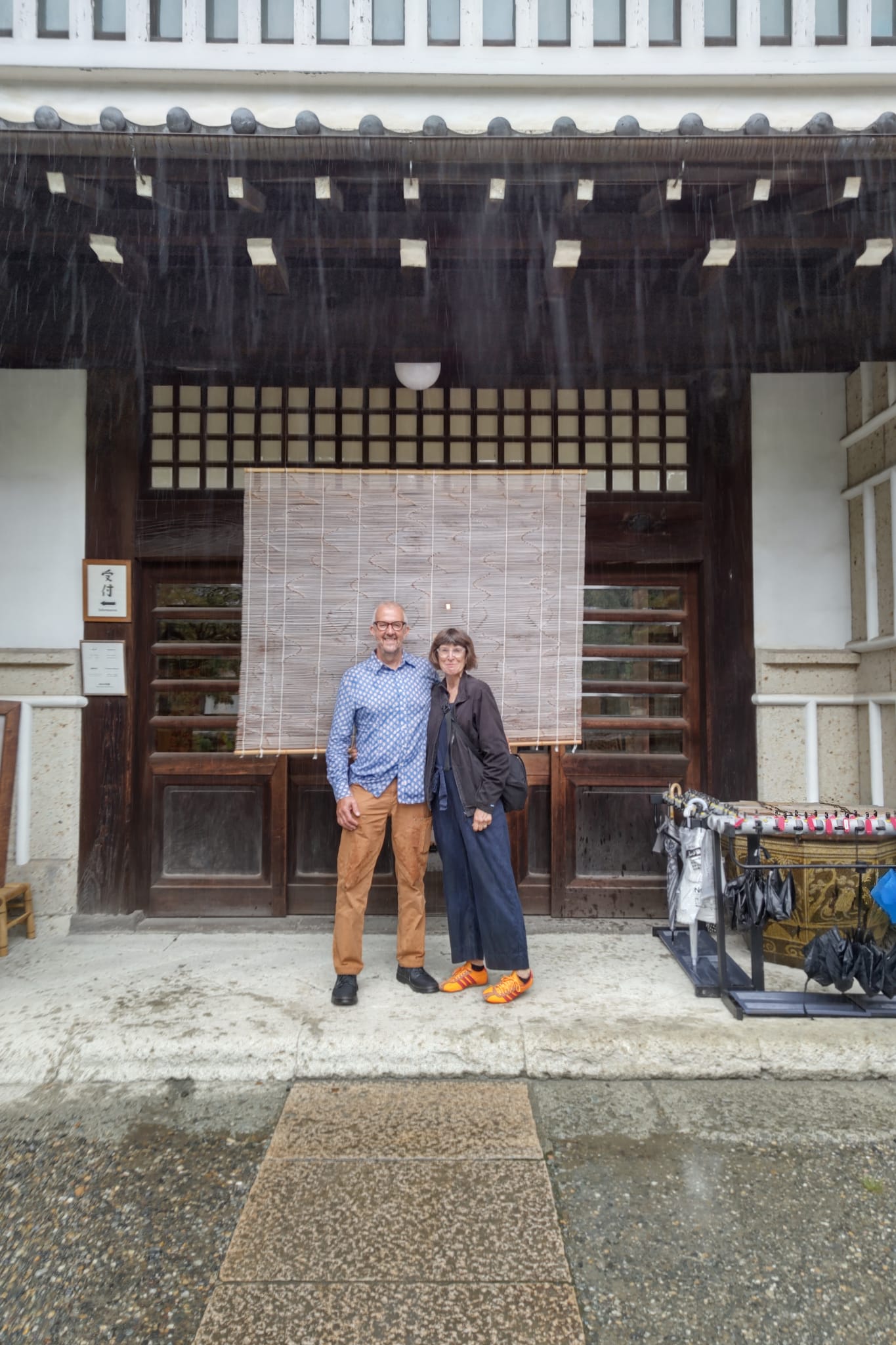
Outside the Japan Folk Crafts Museum (Nihon Mingeikan) in Tokyo. (Chiaki Yokoyama behind the camera.)
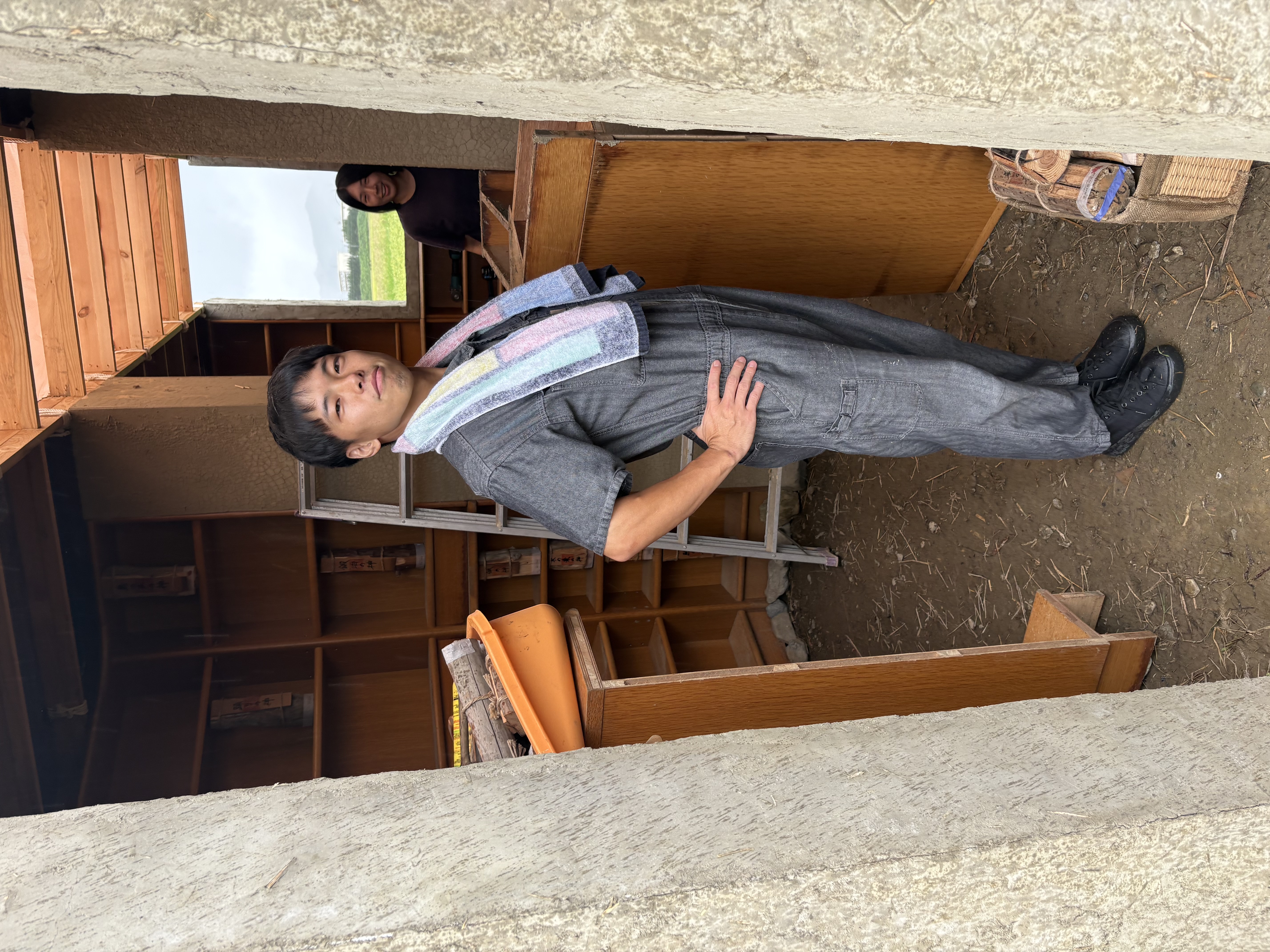
Outside the Japan Folk Crafts Museum (Nihon Mingeikan) in Tokyo. (Chiaki Yokoyama behind the camera.)
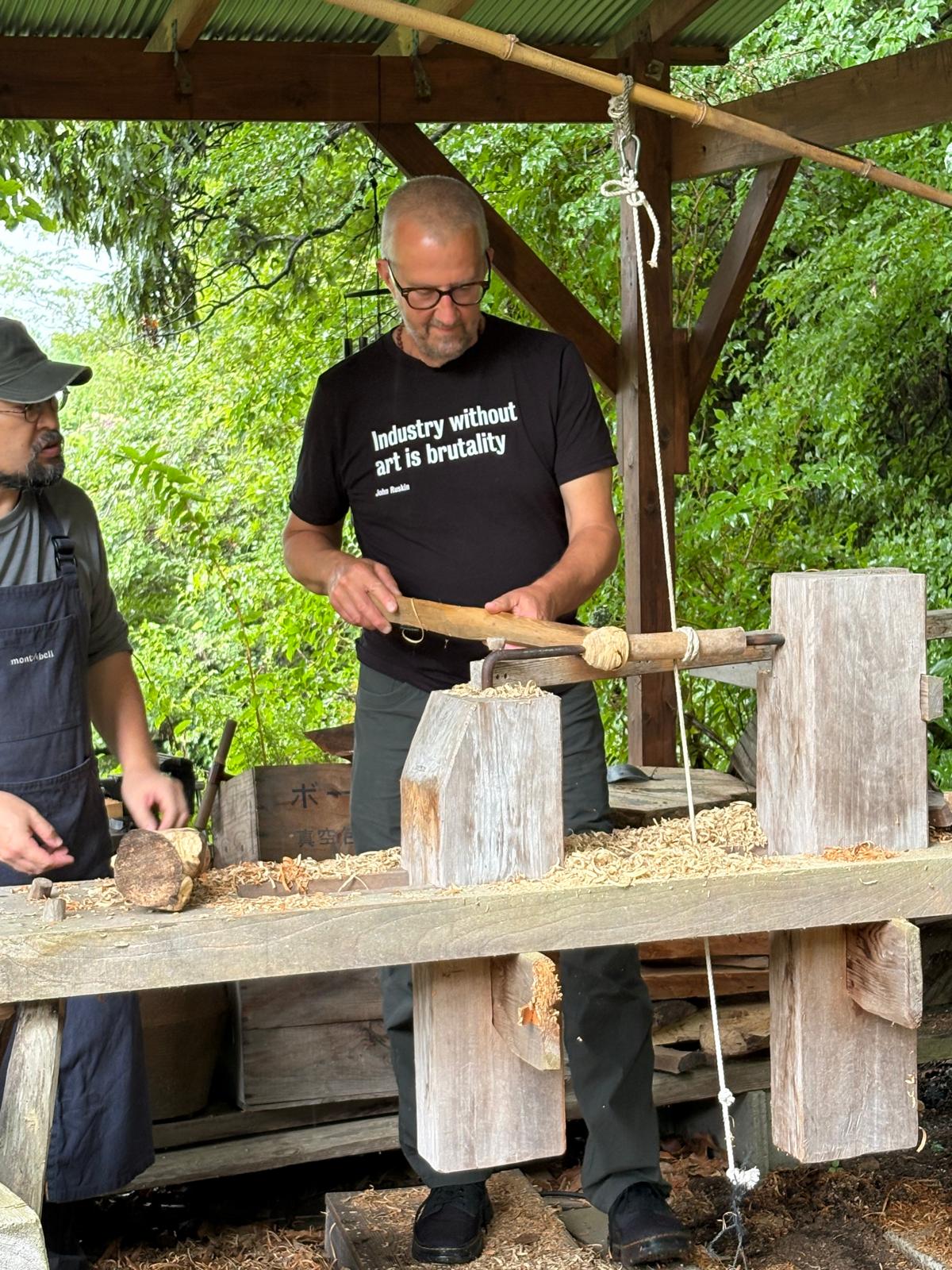
In visiting Japan I was following in the recent footsteps of Guild Companion Bob Richmond, of Motor House Arts, who spent a month there last year, and of Guild Master Rachel Dickinson, who visited in June. My wife Caroline and I stayed at the ORMC guesthouse in Nose, which became our home base for trips further afield to investigate the Japanese philosophy of work, including, for me, a solo stint at a remote Zen monastery in Hyōgo Prefecture (www.antaiji.org/en) to help bring in the rice harvest.
My Ruskinizing lecture at the ORMC on “Work as Waste” was followed by an enlightening public discussion with Ryo Yamazaki, founder of Studio-L and author of the new book Menshiki Keizai (Kobunshu 2025), which translates roughly to “Face-to-Face Economy.” Ryo’s book combines a history of relational ontologies in political and economic philosophy (Ruskin of course looms large) with hands-on examples in practice. I am hopeful that this important and beautifully produced book will soon be translated into English. Meanwhile, I offer a deep bow of gratitude to Companion Chiaki Yokoyama for expertly interpreting my talk and subsequent conversation with Ryo from English into Japanese and vice versa. And, while I’m at it, full prostration bows to new Companions Ikuko Kurasawa, who so ably and helpfully facilitated the whole visit, and Eiji Yoshida, whose amazing organizational and artistic talents give me hope for the future. A highlight of our trip was to see Studio-L’s current installation in an art park in Kameoka (https://kameoka-kiri.jp/art-park-program) — essentially, a vast rice field dotted with stylized farm sheds (nōgoya). The shed Eiji and Ryo Yamazaki’s students from Kwansei Gakuin University have produced is constructed out of repurposed library bookshelves, on which are perched hundreds of short upright logs, each sporting a paper tag with kanji characters representing a different Shinto deity. On display now!
In Kyoto, Toshiko Asai — Companion of the Guild, Founder of Impact HUB, and Director of the UNESCO Association, Kyoto branch — generously organized a memorable dinner with Companion Shokan Nishikawa and his wife Yoko. (Shokan is also involved in UNESCO and Impact HUB and sponsored the Big Draw there in 2019.) The hospitality we experienced with them and indeed everywhere was lavish and we are so grateful for it. The Guild is lucky to have such committed comrades in Japan doing the multi-faceted, human-scaled work of political economy that Ruskin envisaged so long ago.
Even Typhoon No. 25, named Dujuan, which made landfall in Tokyo during our stay, could not quell the buoyant joy we experienced at every turn.
Mark D Usher, October 2026
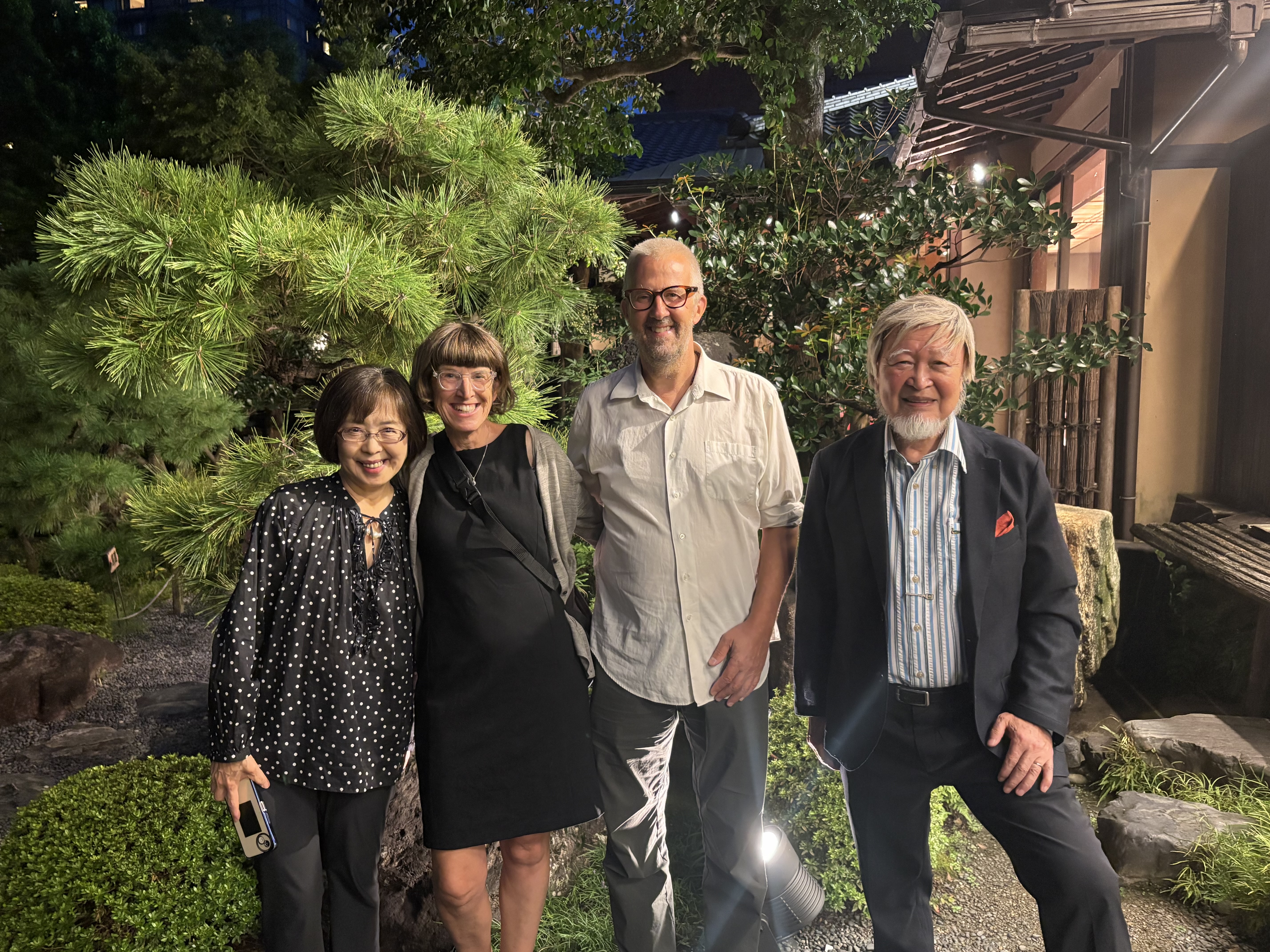
With Shokan and Yoko Nishikawa at Takasegawa Nijōen, an Edo-period house and garden turned restaurant in Kyoto.
With Shokan and Yoko Nishikawa at Takasegawa Nijōen, an Edo-period house and garden turned restaurant in Kyoto.