
FLORENTIA, FIORENZA, FIRENZE, FLORENCE
Miguel Martinez lives in the Oltrarno district of Florence, famous for its (dying) arts and crafts. He and others have been working for ten years on a series of community projects, which he considers very Ruskinian in spirit, putting together radical local democracy, tradition and care for place. He describes it as being something very "political" in the sense of the community, the "polis", but completely outside party politics. Behind the Carmine church, where Masaccio and Lippi worked, he and others run a community garden. Now they're working on a project to turn the abandoned church of San Carlo dei Barnabiti into a community centre too, focusing on local history (which he points out is not the same as the bigger history of Florence), arts and crafts. After he got in touch with the Guild, we invited Miguel to write about these projects for us; he would be delighted to hear from any Companions eager to know more.
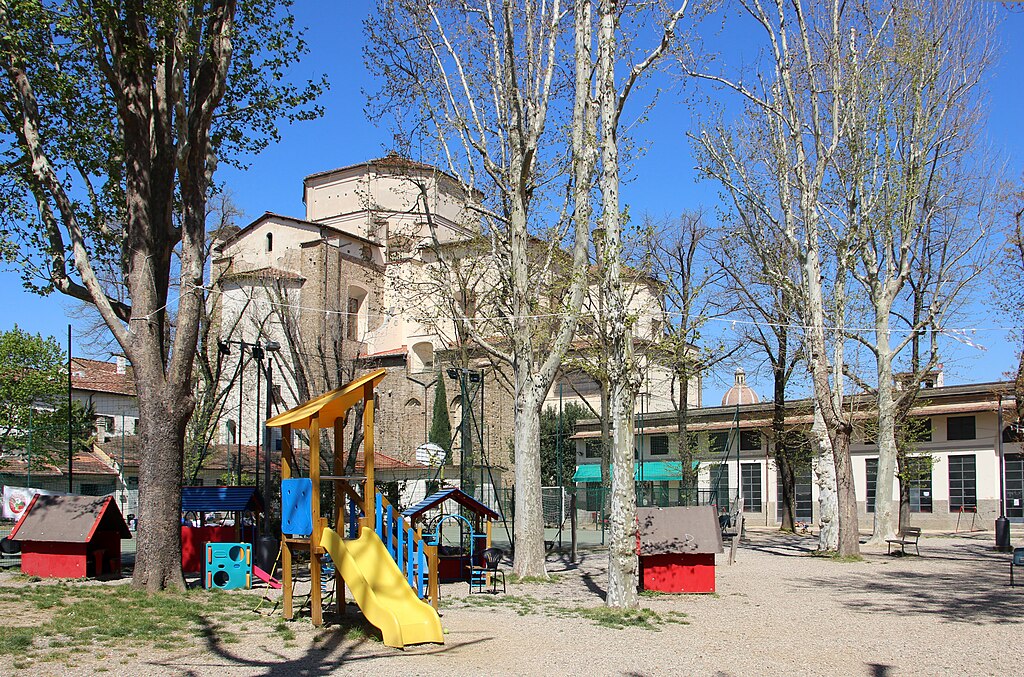
Ardiglione/Nidiaci Garden
Living in the city Ruskin dedicated his Mornings in Florence, I offer a reflection on the four names of our city: Florentia, Fiorenza, Firenze, Florence.
Florentia was the original Latin name, meaning something between “the city of flowers” and “may this city flourish“.
The Umiliati, the humble ones, were a community of men and women, without a leader, appearing from Lombardy, who knew how to work wool, and made this the city of Craft, that strange word that stands all together, for power, skill, mindfulness and a touch of wizardry.
Sheep, pecus, became pecunia, money, and a few families in Firenze found themselves managing the financial flows of a world where money was a rarity.
Yet the families of Firenze lived in a very small world, where they had to give for what they took… and they usually “gave to the Church”, which had a far vaster meaning then than today.
Thus it became the Fiorenza of Dante and the Renaissance, where a small community of merchants and craftsmen left an enormous mark on the world.
The impact was so great that it gave rise to two parallel spaces: one the local, human city of Firenze, one the world-wide, imaginary city of Florence.
At the end of the 19th century, the 25,000 Anglo-American residents in a city of 200,000, had an enormous impact, often for the better: to cite a forgotten example, the English writer Vernon Lee did more to save Florence from destruction by its own "progressive" citizens, than any one else.
Yet, inevitably, there was a weak point in the relationship: the "Anglos" who knew every fresco by Giotto but often knew no Italians personally.
Florence, like all beautiful things, easily shifts from a dream to a commodity: Ruskin's first daguerrotypes have expanded into hundreds of millions of selfies, in the long wake of Thomas Cook's first commercial tour to the city in 1867. With a tremendous impact on daily life, but also an even greater gap between Firenze and Florence, which residents speak of as "the Disneyland of the Renaissance".
From here, the idea of working on healing the relationship between Firenze and Florence, through grassroots commoning by active citizens, involving those who have fallen in love with our city, especially but not exclusively artists.
My experience of becoming a true citizen of Firenze began not so many years ago. I had been living for several years in the Oltrarno district and was already a parent, with two children, aged eight and five.
I used to take them to play at a space which the Municipality kept open for the children of the neighbourhood. A large, roofed area and behind it, a garden with an ancient yew tree, extending to the back of the Carmine church where, to simplify a bit, “the Renaissance began“.
One day, we found a notice on the door, saying the Ludoteca was “temporarily closed”, with no further explanation: we discovered that the whole building and a large part of the garden had been bought by a gentleman from Naples who used to sell small ads door to door in a local newspaper, then decided to change business and bought some fifteen historic palazzi in Florence: after a short spell under house arrest, he is currently in Dubai, selling skyscrapers in the Metaverse against bitcoins. An extraordinary lesson on the difference between a place as a shared experience, and a place as an asset, with a purely speculative value.
Talking with the other parents picking up their children up at school, we organised meetings, made a couple of demonstrations, learned how to set up an association. On May 6, 2013, the Municipality gave us the keys of the surviving part of the garden.
Twelve years later, the garden, under the double name of “Ardiglione/Nidiaci” is many things: the only safe green space in the centre of Firenze for children, a place where parents from around the world can talk to each other and become friends around a shared responsibility (identity is not where our fathers were born, but where our children are raised), a roofed space for concerts, lectures and community life, and much else.
It is also the prime example in Firenze of what is called a “shared governance agreement“: we, as "active citizens" seeking the "general interest" and not our personal profit, propose and run the Garden together with the Municipality of Firenze. This is a useful article in English about the garden https://www.bollier.org/blog/nidiaci-garden-florence-oasis-commoning-busy-city
Firenze is a city where there are nearly 50 tourists a year for every resident; and most of the money those tourists spend does not flow into the pockets of the average fiorentino; indeed, a large part ends up in the hands of investors from countries ranging from the UK to Qatar to Israel. Short term rentals require countless evictions; young people who have won a competition for a job in the local hospitals or schools have to say no because the rents are too high; and each fiorentino with his taxes pays to clean up after 50 tourists.
The millions coming to see authentic Florentine craftsmen at work, should be advised that most have been evicted, to make way for places like Burgerence, which I suppose means “eat a hamburger in Florence“. A sign on one restaurant gives clear marching orders to the tourists: "WHEN IN FLORENCE EAT PIZZA DRINK SPRITZ REPEAT".
All of this leads many Fiorentini to look askance at Florence. Yet there is another side to the relationship.
Back to the Garden: the Garden today allows the local residents to enjoy the place they live in, and children to grow up thinking it is theirs, a place they love and take care of, and don’t merely want to rent out.
As my then-thirteen year old son put it, entering Boboli garden during the Covid epidemic, “what if I had been born in Wuhan?“
Before we had the keys to it, we had no idea of where the Garden came from. In the town archives, we dug up a notary’s deed, dated August 3rd, 1920. We discovered that this island of resistance, owes its existence to Edward Otis Bartlett, “Commissioner of the American Red Cross to Italy.”
World War One, the United States made what was probably its first great world-scale public relations stunt with the American Red Cross (ARC), and invested enormous funds to show how a big and benign power could help the widows and children of the Italian men being uselessly slaughtered in the trenches; and once the war was over, Bartlett decided to use ARC funds to leave a permanent donation to the real people of what was then the poorest district of Florence.
Edward Otis Bartlett, the best alumnus of his year at Brown University, who spent most of his life in Firenze, in the university bio left us a motto – “living — the greatest of the arts“, and a note tells us that “He loved Italy as he loved living“.
Edward Otis Bartlett is Florence; we are Firenze, and we need each other.
The aura-world of “Florence” is closely related to John Ruskin and his political ideals, of community, crafts and profound human relations.
Firenze is inevitably the twin of Florence, and this means that when one tries to deal with apparently practical issues like the thousands of off-the-books underpaid Peruvians running from b&b to b&b on their bicycles to change the laundry (God alone knows where they sleep), simple "politics" is not enough: everything leads back to the duality, Firenze-Florence: there is no way out without art.
With this idea in mind, a year and a half ago we started a collaboration with the Pneuma Art Foundation of Miami, which envisions
"a future where the essence of the Renaissance lives on, not confined to history books, but thriving in the hands of a new generation of artists. Our commitment is to support and empower these emerging talents through a modern interpretation of the Master's Workshop."
The Foundation originally began with a quest for spaces for young artists – generally foreign born and living in Florence - of the "Renaissance, Baroque and Classical tradition" to practice and use as workshops; we entered this project with the idea of combining the workshops, with spaces run for and by the local community – as were the Renaissance botteghe.
The Frilli Gallery, which since 1860 has been making replicas of famous artworks using traditional methods, joined us by providing their unique copy of Lorenzo Ghiberti's Gate of Paradise, the doorway all Florentines had to pass to be baptized in the Baptistry.
The Municipality of Florence gave us the most significant exhibition space in the city, the Sala d'Arme of Palazzo Vecchio, for The Path to Paradise, a two-week show of artworks by 37 artists from around the world (see image below), inspired by the ten panels of the Gate of Paradise.
The next step will be to reclaim community spaces, property of either the municipality or the Church, to build this view of a shared citizenship between Florence and Firenze.
We would love to hear any suggestions and ideas from the Companions of the Guild: please feel free to write to pneuma.italy@proton.me
MIGUEL MARTINEZ
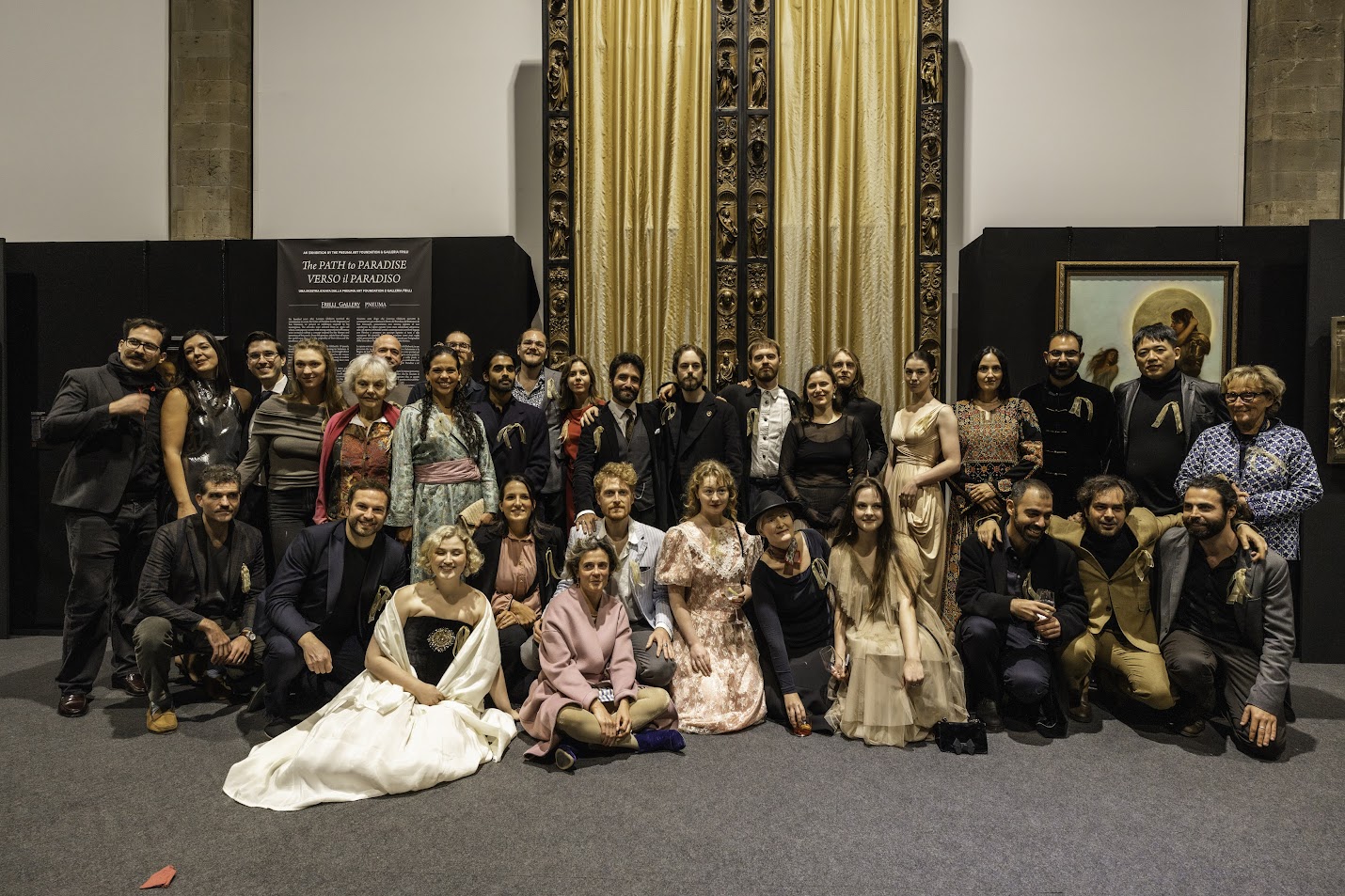
The Path to Paradise exhibition